The data that Openaid show and visualize goes through a process before it is distributed. Here is an explanation of how this is done.
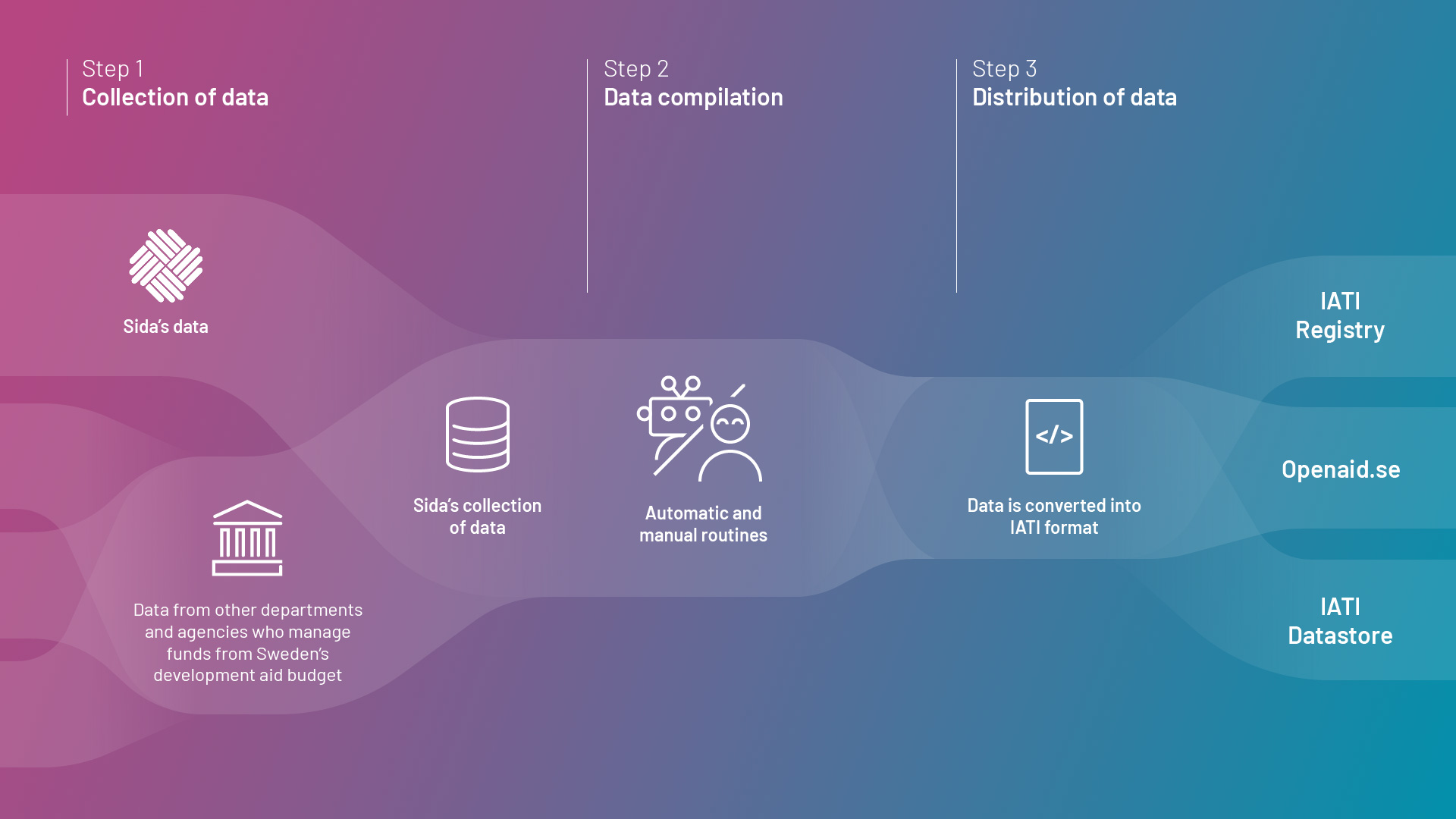
Step 1: Collection of data
Sida collects data about projects from the agencies and ministries that control funds within the Swedish Government’s Expenditure Area 7: International Aid. Sida collects data in different formats and at different times. Sidas’s own information is collected through the internal systems used by the agency in its daily work.
This data consists of both descriptive data, such as transactions, budgets, statistical markers, project description and project targets and results, as well as documents prescribed for distribution, such as decisions and agreements. Typically, data applies to individual projects, but in some cases contributions are grouped and their transaction data is aggregated.
Step 2: Data compilation
Data from the agencies and Sida’s own project data are quality assured through both computer-assisted (automatic) and manual routines.
Step 3: Distribution of data
The quality-assured data is formatted into format and then sent to IATI’s central registries, the IATI Registry, IATI Datastore and openaid.se. Openaid loads this IATI data and displays the data on Openaid in the form of web pages.
The data available on Openaid is also available in the IATI Registry and IATI Datastore, via tools on each website or via the Application Program Interfaces (API).
API
An Application Program Interface (API) acts as a link between an application and the data that the application is going to load.
Openaid uses the API provided by IATI Datastore. It provides access to all published IATI data and not only Sweden’s files displayed on Openaid. Read more about how IATI Datastore works here.
There is also an IATI Registry API that contains metadata for files published in IATI XML format. Read more about it here.